
Wardrobe
Why 90% of your wardrobe is black (and what to do about it)
 Ragini Tripathi · 27 September 2026 · 7 min read · Comments
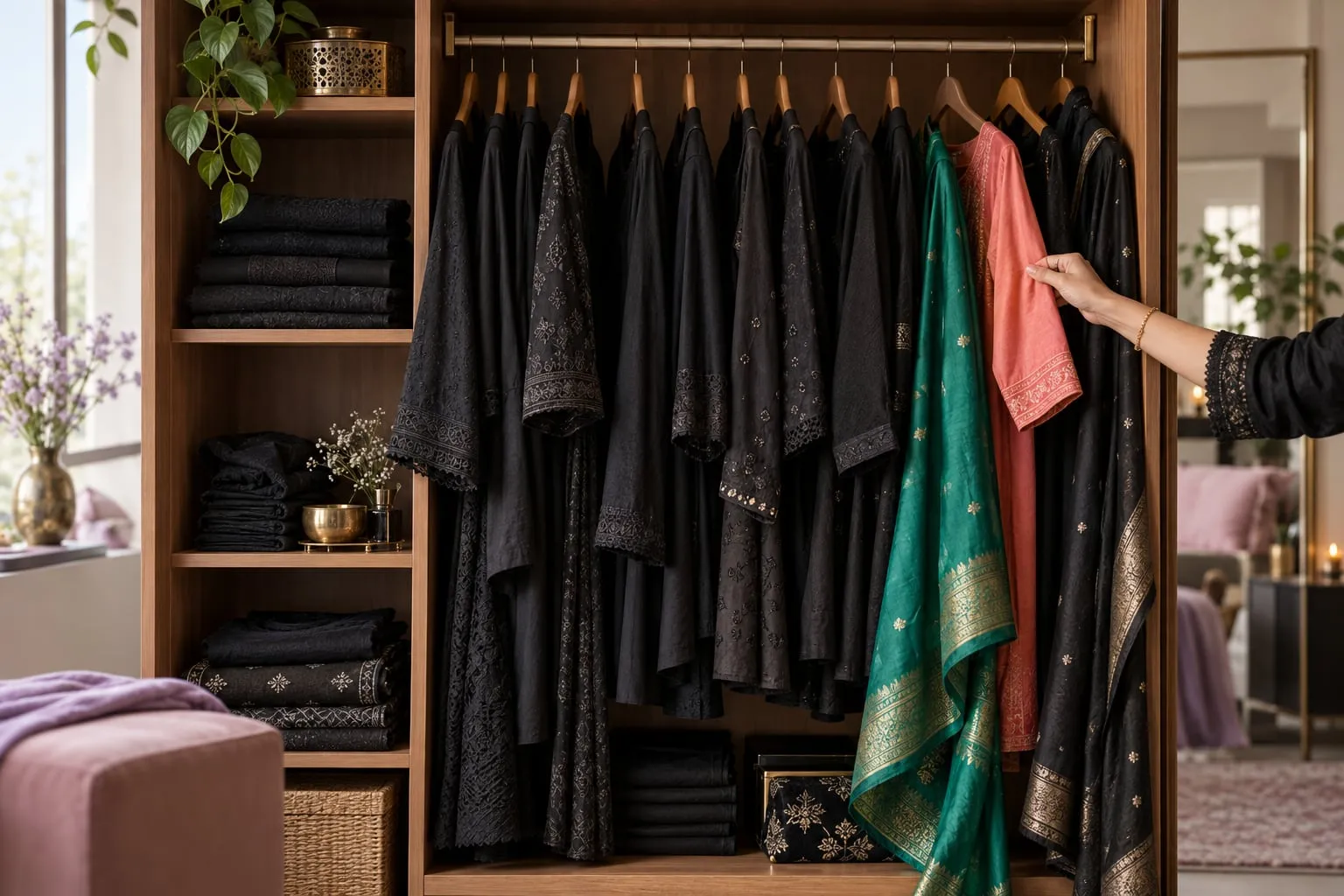
Open your cupboard. Count the black. If it is most of what you own, you are not a minimalist. You are avoiding a decision.
I say that with love, because I have seen this cupboard in almost every city I work with. Black trousers, black kurtas, black tops “for office”, a black saree “for parties”, and one bright dress bought in a brave moment and never worn. If this is you, you are in very good company. And you are also spending money on a wardrobe that is doing a fraction of what it could do for you.
How black quietly took over your cupboard
Nobody decides to own a black wardrobe. It happens one safe purchase at a time. These are the reasons I hear most in first sessions:
- “It never clashes.” True. Black goes with everything, so it removes the fear of getting a combination wrong.
- “It looks classy.” Black reads as serious and expensive, especially in offices and at evening events.
- “It hides things.” A lot of women reach for black to hide a tummy, hips or a bad day.
- “I don’t know what else suits me.” This is the real one. When you are unsure of your colours, black feels like the answer that cannot be wrong.
- “Everyone else wears it.” At work, at parties, in the family WhatsApp photos. Blending in feels safer than standing out.
Every one of these is understandable. None of them is actually about black suiting you.
Quick question: which of these five sounds most like you? If you nodded at more than one, you are in very good company. Keep reading.
Black is a shortcut, not a choice
Here is the part that surprises people: black is not bad. For some people it is genuinely one of their best colours.
In my sessions I always test black against brown next to the face. For some clients, black is the clear winner. It evens out the skin, sharpens the jawline and makes the eyes look striking. Those are usually cool, high-contrast people, the ones I call Winters. For them, black is not a hiding place. It is power.
For many others, the same black does the opposite. It deepens the shadows under the eyes and around the mouth, pulls the colour out of the face and makes them look more tired and a little older than they are. In photos they look serious, even stern, when they feel perfectly happy. They have been calling that look “classic” for years.
So the question is never “is black good or bad?” It is “is black yours?” If it is not, you have been wearing your least flattering neutral every single day.
Try this now: open your phone gallery and find two photos of yourself, one in black and one in a colour. Look at your face, not the outfit. In which one do you look more rested?
The hidden price of playing it safe
It costs you in photos and on video. Your face is what people remember. If the colour closest to your face drains it, every Zoom call, every wedding album and every LinkedIn photo shows you slightly dimmer than you are.
It costs you outfits. A wardrobe of one colour looks like it should be easy to wear. In practice it gets boring fast, so you buy more, looking for something that feels new. Research on wardrobes shows the average one holds around 198 garments, with about 22% unworn for a whole year. The fix researchers found is not buying more. It is wearing what you own in new combinations. A cupboard of black has very few combinations to offer.
It costs you presence. Clothes change how others read you, and there is good evidence they change how you feel as well. People report feeling most authoritative in formal wear and friendliest in casual. Colour is part of that message. Head-to-toe black says “serious”. That is useful sometimes, but not when you want to look approachable, warm or creative.
How to break up with black (gently)
1. Find out whether black is yours
Do this at home in five minutes. Stand at a window in daylight, no makeup, hair tied back. Hold something black under your chin, then something navy, then something chocolate brown, then charcoal grey. Look at your skin and eyes, not the fabric. The one that makes you look rested and clear is your best dark neutral.
If black wins, keep it and build around it. If something else wins, that is your new black.
2. Meet your real “black”
Every colour season has a dark neutral that does black’s job, looking serious, sharp and slimming, without draining the face:
- Deep and Bright Winters: true black is yours. Pair it with crisp white, icy tones and jewel colours.
- Autumns: chocolate brown, espresso, deep olive or warm charcoal. Richer and kinder on warm skin.
- Springs: navy, warm charcoal or golden brown. Fresher and lighter than black.
- Summers: soft charcoal, slate navy or cocoa. Gentle depth without harshness.
3. Keep black below the waist
You do not need to throw anything away. Move black away from your face. Black trousers, skirts and palazzos are perfectly fine. Put your best colour on top, near your face, where it does the work. In Indian wear, the same idea applies to the dupatta: a black suit with a dupatta in your colour instantly lifts the whole look.
4. When you do wear black near your face, cheat
Some days black is the dress code. Use my Session 3 tricks for wearing colours outside your palette:
- Choose a lower or more interesting neckline, like a V, keyhole or cowl, so there is distance between the black and your face.
- Add a collar, scarf or statement earrings in one of your colours.
- Get the lip colour right. When the outfit is off-palette, your lipstick matters most, because it sits directly on the face.
- Choose your metal. Silver with black suits cool colouring; for warm colouring, gold softens black beautifully.
5. Take the thirty-day colour challenge
Change your wardrobe slowly, not in one expensive weekend:
- Week one: wear your “real black” neutral instead of black three times.
- Week two: add one colour near your face every day, a top, scarf or dupatta.
- Week three: try one outfit with two of your colours together.
- Week four: notice the compliments. They usually start in week two.
When you do shop again, follow one rule: one in, one out. Every new piece must work with at least two things you already own.
Quick question: if you could replace only one black piece this month, which one would it be? Start there.
“But I need black for the office”
Many women tell me black is their “office uniform” because they want to be taken seriously. It is a fair goal, and there is research behind it: more formal clothing raises how competent people judge you to be. But formality comes from structure, fabric and fit, not from the colour black.
A well-cut navy blazer, a charcoal sheath dress, a deep teal or burgundy kurta with a structured jacket: all of these read as authoritative, and on the right person they look more expensive than black because they do not drain the face.
“But black is slimming!” Is it?
Dark colours do create a smoother silhouette, because they hide shadows and folds. That works with any deep shade in your palette, not only black. A chocolate brown, deep plum or navy slims just as well, and flatters your face at the same time. You can have both.
Black should be a choice, not a habit
Once you know your season, black stops being the default and becomes one option among forty. You open your cupboard and see combinations instead of a wall of safe choices.
That is what clarity looks like. And it usually starts with one session and one honest look in daylight.
So tell me in the comments below: what is the one black piece you could never give up? I promise not to judge. Much.
Your turn
What is the one black piece you could never give up?
Share your experience or ask me a question. No login needed. I read every comment and reply to as many as I can.